
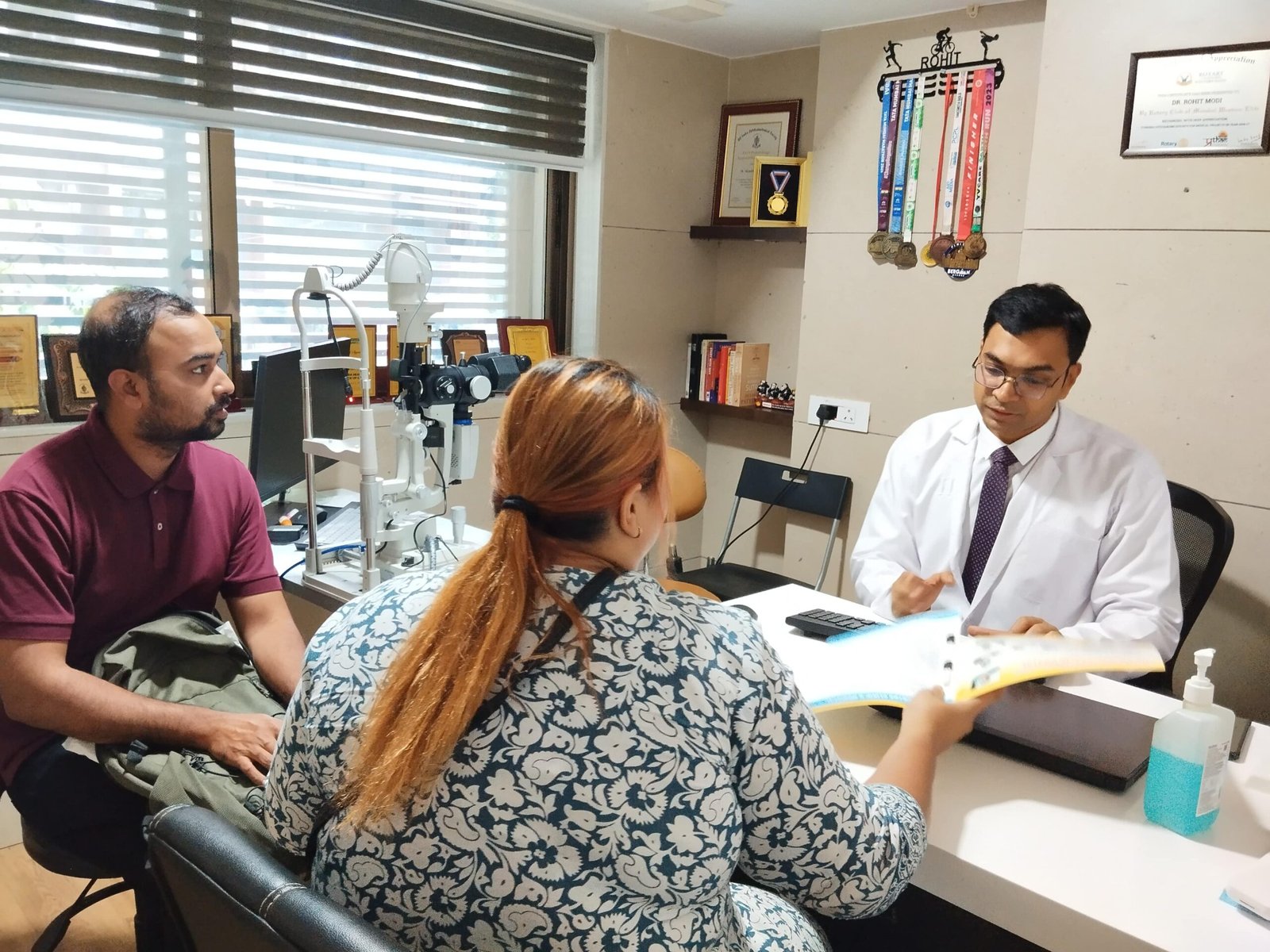
A pre-LASIK work-up includes refraction, corneal thickness measurement (pachymetry), corneal topography and tomography, dry-eye evaluation, pupil assessment, a dilated retinal examination where indicated, and a complete eye-health check. Together these tests decide whether LASIK — or any refractive procedure — is safe for your eyes.
Why so many tests for a five-minute procedure?
\nLASIK permanently reshapes the cornea. The safety of that decision rests entirely on measurements taken beforehand — this work-up is where good refractive surgery actually happens.
\nThe tests, one by one
\nRefraction (spectacle power)
\nYour exact prescription is measured, often in two ways (with and without dilating drops), and compared with previous records to confirm stability.
\nPachymetry (corneal thickness)
\nUltrasound or optical pachymetry measures corneal thickness at the centre and thinnest point. This determines how much tissue can safely be treated.
\nCorneal topography
\nMaps front-surface curvature to detect irregular astigmatism and early keratoconus. Read the topography guide.
\nCorneal tomography
\nWhere used, tomography images the front and back corneal surfaces and maps thickness across the whole cornea — the most sensitive screening for ectatic (weakening) change.
\nDry-eye evaluation
\nTear break-up time, surface staining and gland assessment identify dry eye, which is treated before surgery to improve measurement accuracy and healing. About dry eye.
\nPupil assessment
\nPupil size in dim light is measured and considered in planning the treatment zone and counselling about night-vision effects.
\nDilated retinal examination
\nWhere indicated — especially for moderate-to-high myopia — the retinal periphery is examined for thinning or holes, which are treated before any refractive surgery. High power and eye health.
\nComplete eye-health check
\nEye pressure, lens clarity, eyelids and general ocular examination complete the picture, along with your medical and medication history.
\nPreparing for the work-up
\n- \n
- Stop soft contact lenses for the period advised (often several days to two weeks; longer for rigid lenses) so the cornea returns to its natural shape. \n
- Bring old spectacle prescriptions if available — they help establish stability. \n
- Expect dilating drops; near vision may blur for a few hours, so plan travel accordingly. \n
After the work-up, your results are reviewed with you and a procedure recommendation — LASIK, PRK, ICL or no surgery — is made from the data. Book a refractive evaluation.
Information on this page is for general education and does not replace an examination, diagnosis or personalised medical advice from a qualified eye-care professional.
FAQs: Tests Required Before LASIK: The Complete Work-Up
Typically 1.5–2.5 hours including dilation time. The consultation and decision discussion happen the same day in most cases.
Lenses temporarily mould the cornea and can falsify curvature and thickness readings. Pausing wear ensures measurements reflect your true corneal shape.
Related treatments & topics
Corneal Topography: What the Map Shows & Why It Matters
Corneal topography is a painless imaging test that maps the curvature of the cornea's front surface, displayed as a colour map. It…
Learn moreLASIK Specialist in Mumbai
LASIK is a laser procedure that reshapes the cornea to correct myopia, hyperopia and astigmatism. Eligibility depends on corneal t…
Learn moreLASIK Eligibility: What Actually Decides If You Can Have LASIK
LASIK eligibility is decided by a combination of factors: adequate corneal thickness, a regular and stable corneal shape on topogr…
Learn more