
A cataract is clouding of the eye's natural lens, causing blurred vision, glare and faded colours. Surgery — removing the cloudy lens by phacoemulsification and implanting a clear intraocular lens (IOL) — is the only effective treatment and is advised when cataract interferes with daily life. Dr. Shraddha Sureka offers modern micro-incision cataract surgery with personalised IOL selection at Sentra Clinic & Hospital, Malad East, Mumbai.
What is a cataract?
\nInside the eye, behind the coloured iris, sits a clear natural lens that focuses light. With age, its proteins gradually change and the lens turns cloudy — this is a cataract. It is not a film growing over the eye and cannot be dissolved with drops or reversed with diet; the only effective treatment is replacing the cloudy lens surgically.
\nHow cataract develops
\nAge-related change is by far the most common cause, usually appearing after 60 but often beginning earlier. Cataract also develops earlier or faster with diabetes, prolonged steroid use, eye injury, previous eye surgery or inflammation, high myopia, smoking and strong lifelong UV exposure. Occasionally children are born with or develop cataract.
\nSymptoms
\n- \n
- Gradually blurred or hazy vision, like looking through a smudged window \n
- Glare and halos around lights; difficulty with oncoming headlights at night \n
- Colours looking faded or yellowed; needing brighter light to read \n
- Frequent spectacle changes; sometimes temporary "second sight" where near vision briefly improves \n
- Double vision in one eye in some types \n
Diagnosis
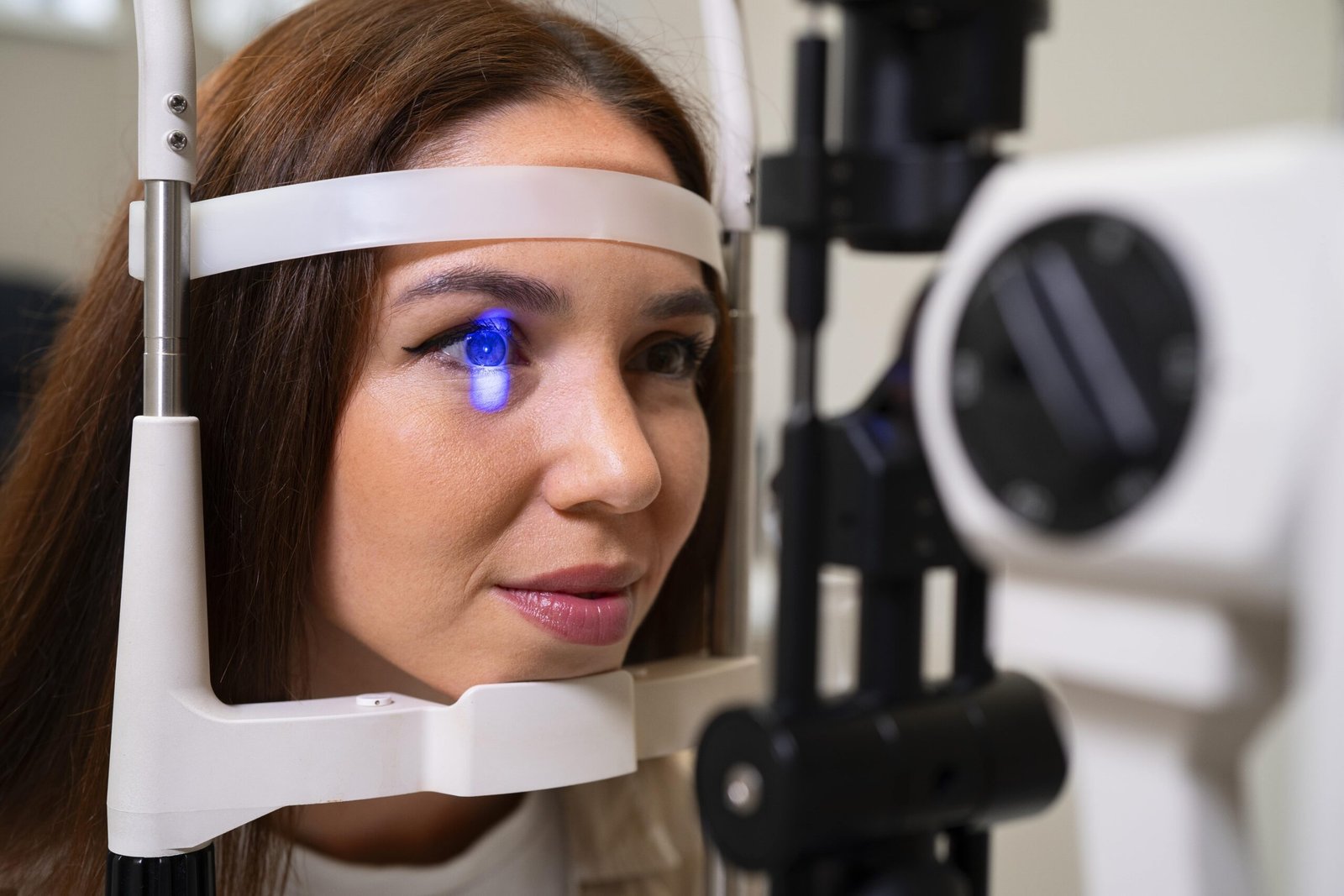
\nA dilated slit-lamp examination shows the type and density of the cataract and checks the rest of the eye — retina, optic nerve and cornea — because these determine how much vision surgery can restore. When surgery is planned, biometry measures the eye to calculate the implant power, and the cornea is assessed for astigmatism.
\nWhen is surgery considered?
\nThe modern answer: when the cataract interferes with the life you want to lead — reading, driving, work, hobbies — not when it reaches an arbitrary "ripe" stage. Waiting for maturity is an outdated concept that makes surgery harder, not safer. Occasionally surgery is recommended earlier for medical reasons (e.g. the cataract prevents retinal examination or is itself harming the eye).
\nCataract surgery: phacoemulsification
\nModern cataract surgery uses ultrasound energy delivered through a micro-incision (around 2–3 mm) to break up and remove the cloudy lens — a technique called phacoemulsification. The procedure is typically done under local (drop) anaesthesia as a day procedure, takes about 10–20 minutes in straightforward cases, usually needs no stitches, and the natural lens capsule is preserved to hold the implant. Detailed phaco guide.
\nThe lens implant (IOL)
\nA clear artificial intraocular lens is placed inside the natural lens bag. Its power is calculated from your preoperative measurements; its type is chosen around your eyes and lifestyle:
\n- \n
- Monofocal — sharp focus at one distance (usually far); reading glasses still needed. \n
- Toric — also corrects pre-existing corneal astigmatism. \n
- Multifocal / trifocal — designed to provide distance, intermediate and near focus in suitable eyes. \n
- EDOF — extended-depth-of-focus designs, where offered, favour a continuous range with fewer optical trade-offs for some patients. \n
No lens is universally "best" and no lens can guarantee complete spectacle independence for everyone — suitability depends on your eyes. Compare IOL options in detail.
\nRecovery and follow-up
\n- \n
- Vision usually begins clearing within days and stabilises over weeks. \n
- Antibiotic and anti-inflammatory drops are used for a few weeks as prescribed. \n
- Avoid rubbing the eye, dusty exposure and heavy strain initially; normal routine resumes quickly. \n
- Reviews typically occur the next day, and then as scheduled; the final spectacle check follows stabilisation. \n
Risks — honestly
\nCataract surgery is among the safest and most successful operations in medicine, but it is still surgery: infection (endophthalmitis, rare), swelling, pressure rise, capsule complications, retinal detachment (a small lifetime risk, higher in high myopes) and the common, easily laser-treated late clouding of the capsule ("after-cataract") can occur. Your individual risk profile is discussed before consent.
\nDr. Shraddha's approach
\nCareful biometry and corneal assessment, honest IOL counselling around your real visual priorities, meticulous micro-incision surgery and structured follow-up. Patients with diabetes receive coordinated retinal evaluation as needed. Consultations at Sentra Clinic & Hospital, Malad East. Book an appointment.
Information on this page is for general education and does not replace an examination, diagnosis or personalised medical advice from a qualified eye-care professional.
Related treatments & topics
Cataract Surgery: Procedure, Recovery & Results
Cataract surgery removes the cloudy natural lens and replaces it with a clear intraocular lens, usually via micro-incision phacoem…
Learn morePhacoemulsification: Modern Micro-Incision Cataract Surgery
Phacoemulsification ("phaco") is the modern standard for cataract removal: the cloudy lens is broken into tiny fragments with ultr…
Learn moreIntraocular Lens (IOL) Options: Monofocal, Toric, Multifocal & Trifocal
The intraocular lens implanted during cataract surgery comes in several designs: monofocal (one sharp distance), toric (also corre…
Learn more